
Four Incredible African American Architects You Should Know

America’s very first Black licensed architects started appearing in the mid-1800s following the Civil War. Securing commissions in a white-dominated profession, especially after the enforcement of Jim Crow laws, was not easy. But as African Americans grew their communities, they needed trained architects to build their businesses, banks, churches, schools and more. These trailblazing men and women, who faced obstacles due to overt racism, were the architects that helped to leave a lasting mark of professionalism and workmanship in a multitude of buildings that history often overlooks.
Here are four architects you should know.

Julian Abele (1881-1950)
Julian Abele was a prolific and prominent American architect born and raised in Pennsylvania.
Even while working on his education, his experiences were broad and his resume rich. Julian Abele was a bright student, recognized by faculty and peers, alike. After delivering his high school class’ commencement address, he became the first African American student admitted to the Department of Architecture at the University of Pennsylvania.
His entire life, Abele was a true designer and maker, even creating all of his own furniture and designing homes for family members. He loved to paint, draw, work with precious metals, and more.
Professionally, Julian Abele contributed to the design of some 400 buildings, from museums to universities to libraries and houses of worship. Working in the offices of Horace Trumbauer where he advanced to chief designer status, Abele is credited with designing the exterior terracing of the Philadelphia Museum of Art, including the front steps made famous in the 1976 film, Rocky. Though he had many, other notable works include the Widener Memorial Library at Harvard University, Philadelphia’s Central Library, as well as Duke University’s West Campus and Cameron Indoor Stadium.
Beverly Greene (1915-1957)

Beverly Loraine Greene was the first African American woman to be registered as an architect in the Unites States. Born and educated in Chicago, she quickly began breaking boundaries- geographical and societal.
Though her college campus had integrated upon her arrival, Greene was the first African American woman to graduate with a Bachelor of Science degree in architectural engineering. Later, she would also become the first African American woman to earn a master’s in city planning and housing.
Beverly Greene’s career and architectural creations took her all over the world. From New York City’s Stuyvesant Town, theater design at the University of Arkansas, designs for New York University, and the UNESCO United Nations Headquarters in Paris.
Unfortunately, Beverly Loraine Greene passed away at 41 years of age before some of her designed buildings were completed and opened to the public. Still, much was accomplished in her lifetime and her far-reaching legacy lives on through incredible architectural prowess.

Harvey Gantt (1943)
Harvey Gantt is a celebrated architect and politician with a career focus on philanthropy, equality, and the intersection of urban planning and architecture.
Born in what was a then-segregated South Carolina, Gantt was a true trailblazer in his community at many levels. Determined to pursue his passion and build a future through his education, Harvey Gantt became the first African-American student to be accepted at Clemson University, overcoming a legal battle to do so. Later, Gantt would graduate from Clemson with honors in 1965, earning a Bachelor’s degree in Architecture. From there, he went on to earn his Masters in City Planning from MIT.
In 1971, Harvey Gantt founded Gantt Huberman Architects in Charlotte, North Carolina. The firm has since developed some of Charlotte’s most iconic landmarks including the TransAmerica Square, Charlotte Transportation Center, ImaginOn, the Johnson C. Smith University Science Center, and the Friendship Missionary Baptist Church. Before being acquired by and joining Bergman Associates, the Gantt Huberman firm was known for their excellence and proven expertise in the design of higher education environments.
Amaza Meredith (1895-1984)
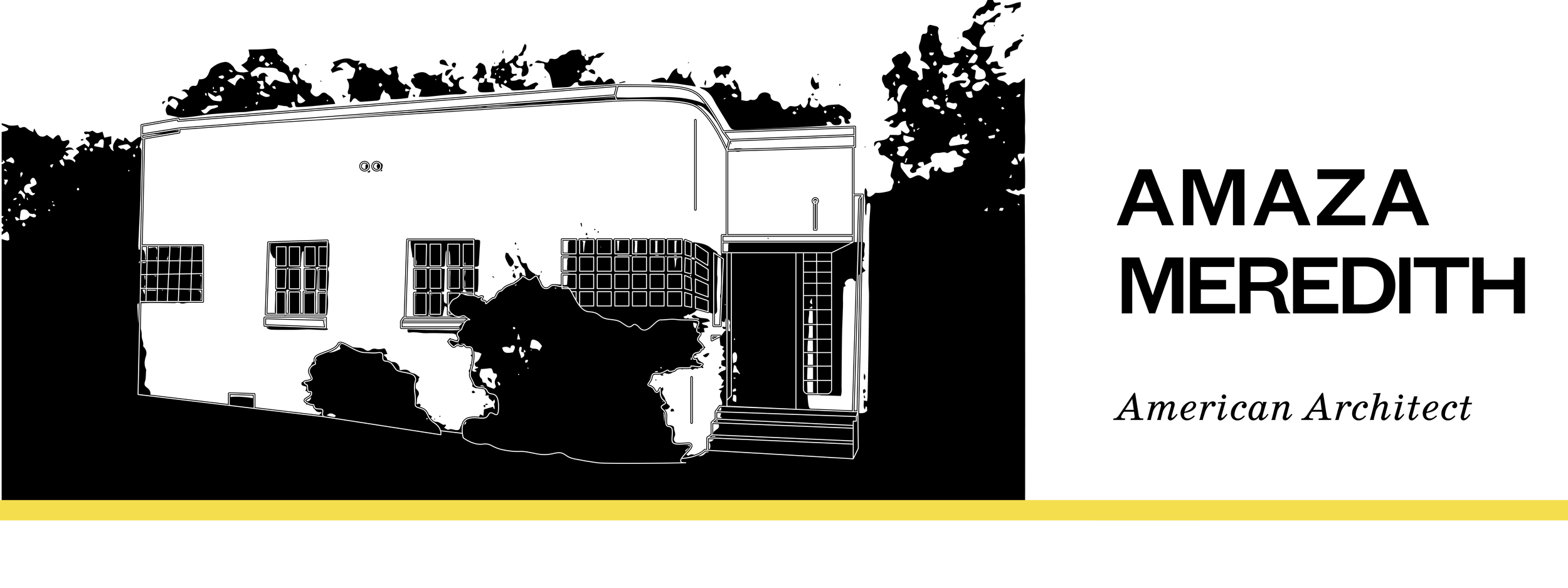
A woman known for many professional talents and aptitudes, Amaza Lee Meredith was a teacher, artist, and architect. All for which she was praised and respected. Born in Lynchburg, Virginia, Amaza’s life and legacy is one of positive impact that spans far beyond a small town.
Amaza’s first educational venture was that of teaching, receiving a teaching certificate from a school now known as Virginia State University. As the years went on and Amaza began to seek continued professional growth and learning, she became the student and went back to university for a degree in teaching, plus two degrees in art education- both a bachelor’s and master’s.
With her newly-earned degrees, Amaza returned to Virginia State University, this time to teach art. Meredith taught art here for years, becoming the department chair. It was while fulfilling this work that a new professional dream began to blossom: architecture and interior design.
Amaza Lee Meredith’s most famous architectural design remains Azurest South, located on the campus of Virginia State University. Azurest South was both Amaza’s home and workplace and is still a well-loved and example of the International Style or Internationalism of the 1920s and ‘30s. Now partially dedicated to the Virginia State University Alumni Association, Azurest South still welcomes visitors and elicits awe.
Sources
Amaza Meredith
Portrait: Thank you to Virginia State University Special Collections and Archives for reference imagery.
Architecture: “Azurest South” by AJ Belongia is licensed under CC BY-SA 3.0
Beverly Greene
Portrait: “Image Reference courtesy University of Illinois Archives (0003076)”
Architecture: “Unesco @ Paris” by Guilhem Vellut is licensed under CC BY 2.0
Harvey Gantt
Portrait: Photo reference of Harvey Gantt is under public domain
Architecture: “Charlotte Transportation Center 04” by WashuOtaku is licensed under CC BY-SA 2.0
Julian Abele
Portrait: Photo reference of Julian Abele is under public domain
Architecture: Photo of the Philadelphia Museum of Art is under the Pexels License
Environments' Elevated App Unlocks Healthy and Intuitive Spaces Through IoT
Environments, a Lighting Environments Company and leader in built environment solutions and IoT integration systems, has launched Elevated Environments today, September 15th. Scalability and flexibility combine to create a platform that integrates multiple smart building systems and IoT products onto a single dashboard. The new application marks the latest addition to the fast-growing Environments ecosystem and will foster health, connectivity, awareness, and holistic wellness. Users of all types will have the ability to enjoy a safe and healthy community while connecting to their workplace.
The all-new app builds healthier, safer, and more efficient environments by leveraging IoT systems supported by Environments.
Proprietary Elevated Environments app bridges digital and physical spaces to build a supportive, accessible, and inclusive metaverse.
The app facilitates the collection of real-time data and analytics from any environment, at any time, allowing managers and owners to keep a pulse on their space.
The Elevated Environments app helps a company’s workforce be happy, healthy, and productive simultaneously. The app allows business owners and operators to optimize their space and resources while receiving invaluable information and support from a single platform customized to their needs and goals. From people mapping, air quality monitoring, and virus detection to germicidal UV (GUV) cleaning, the Elevated Environments platform will create an abundance of actionable insights to promote workplace health and make complex business decisions a breeze. With functions like the ability to remotely book workspaces, place conference rooms on hold, and locate coworkers, the app seamlessly boosts workplace communication and collaboration. It gives users a choice in how they would like to engage within their workplace community.
“The idea for Elevated Environments originated from a desire to build healthy spaces that can improve both our work and personal lives. We wanted to create a simple way to access the information that our office sensors generate and use that data to the absolute best of our ability to ensure that employees are healthy and happy. Our digital and physical spaces should be connected for our common good and operate with care and compassion,” said Erin McDannald, CEO of Environments. “Our new app is designed to better each user’s life by making a space that ‘understands’ and is genuinely good for them. Elevated Environments means having a workplace that cares about keeping you happy and healthy.”

Elevated Environments application on an ipad
The app is driven by proprietary software that leverages Environments’ nearly five-decade design and lighting solutions expertise, smart systems knowledge, and IoT product capabilities. Customers can choose which metrics they’d like to track and which technology will best-serve their specific environment and culture, then decide what they want to do with their collected analytics. In addition to health-related integrations, customers can also opt to use inventory management technology, service and maintenance tracking systems, climate controls, smart lighting and shade automation, and more.
The Elevated Environments app helps key company decision-makers prepare for and adapt to changing situations. Features powered by IoT technology help employees and leadership teams excel in hybrid and in-person environments across manufacturing facilities, offices, labs, warehouses, schools, and more. Designed to make spaces and businesses accessible and inclusive, Elevated Environments offers a metaverse that goes beyond the “digital twin” to create the ultimate hybrid work environment that welcomes and connects every individual. Employees, owners, and guests alike will have the ability to interact with their workspace, teammates, and community easily.
“This new app is a wonderfully inclusive solution that will enrich lives beyond the workplace,” says McDannald. “We are so excited to help our customers reach their full potential for productivity, health, safety, cost-savings, and more. Ultimately, we’re building healthier and smarter spaces for humans.”
Built to suit the needs of any customer or user, the Elevated Environments app will inherit the security settings used within your company. Installing and managing the app on an IoT backbone will allow for seamless integration of multiple building technologies and will give owners the invaluable ability to scale in the future, ensuring the future of their company and employees.
Benefits of Commercial Solar Powered Lighting: More than Money
If you think that commercial solar is only for large, Fortune 500 companies… think again! Large or small, solar electricity is a great way to power any business or organization and lessen its environmental impact.
The cost of solar panels is declining rapidly due to cheaper equipment and tax incentives, putting installation within reach for almost any organization. In fact, solar has now become the world’s cheapest renewable energy source. This is partially due to the fact that the silicon-based solar photovoltaic (PV) panels that convert sunlight directly into electricity continue to become more lightweight, flexible and affordable to produce.
Green energy initiatives are also helping to place solar energy within reach. The cost of solar panels in 2021 is about $20,000 after tax credits. Solar panel costs for a 10-kilowatt (kW) installation in the U.S. ranges from $17,760 to $23,828 after the federal solar tax credit. While any CFO might balk at that price tag, the push toward net-zero buildings enabled by solar yields significant tax rebates and other incentives. Across the board, solar is becoming more affordable and efficient every year, especially for smaller installations.

Here are seven benefits to you may not have considered when evaluating the pros and cons of going solar.
Reduces operating costs: This may seem like an obvious one, but when considering your hefty energy savings, you may want to reimagine your business cost structure. Data compiled by EnergySage, an online solar marketplace, showed that energy savings could be as high as 75% by going solar. Considering that the electricity bill is one of the most expensive bills of running an organization after rent or mortgage, you may want to evaluate how this kind of savings can be utilized in other, more important business ways. For example, the average commercial property owner paid $1,950 in monthly electric bills and only around $500 after installing solar energy systems, according to the report. What could this level of saving do for you?
Green reputation: In addition to saving money, deciding to go solar will have you doing your part to decrease of world’s overall carbon footprint. Solar energy creates no greenhouse gases, and releases no chemicals into the air. It pays dividends in less concrete ways, as well. With visible panels, businesses and organizations literally appear to be environmentally conscious, which will open the door for more grants, funding or positive reputations. You may find that more employees will want to work for an organization that is environmentally friendly, especially younger populations.
Federal Investment Tax Credit: Currently, the most popular tax credit for going green is the Federal Investment Tax Credit, though there are several other green energy solutions being proposed under the Biden administration. Business owners who have just installed their solar solutions will receive a federal tax credit for 30% of the cost of the system. This is significant because eligible taxpayers get a dollar-for-dollar reduction in the amount of income tax they would otherwise owe.
Other tax deductions and rebates: Other tax deductions can be made from the installation of a solar electricity system, including something called accelerated depreciation. These deductions make it possible to deduct up to 85% percent of the value of your solar power system from taxes each year. Different states have separate tax credit incentives based on where you do business. In addition to the tax benefits, some utility companies offer rebates to cover a portion of a system, which can help offset set up cost.

Performance-based incentives: Performance-based incentives, or PBIs, will allow you to get payment for electricity produced by your solar solutions. Compensation is calculated on the amount of energy (in kWh) a solar solution produces over a given period of time. PBIs help system owners recover the costs of installing a solar energy system. The incentives and eligibility requirements vary depending on your area. For example, in Austin, you must work with a participating contractor to qualify for the PBI.
Potential property value increase: Studies show that buildings with solar power systems have a higher property value and sell faster at a higher price. The greatest potential comes when companies own the building and can take advantage of green energy credits. Owning the solar equipment outright also helps with resale, and it won’t increase your property taxes as other additions or building improvements would. Even if you don’t own the building, there are financial incentives to adopt solar through lease agreements.
Low maintenance: Solar solutions last about 25 to 35 years and require little maintenance. All you need to consider is annual cleaning to keep the panels in a good shape. Solar energy is also a smart way to insulate yourself from future energy price spikes.
The final price of solar energy varies depending on many factors, including location, market size, competition, incentive levels, permitting process and labor costs. It’s important to get a clear picture of potential commercial energy costs from a trusted third-party that can provide expert consulting advice. At Lighting Environments, we are focused on helping to develop a clear and customized corporate lighting strategy tailored to your business. Get in touch with our trained design experts and engineers today to help you find the energy systems and lighting solutions that work best for your company.
Light and Human Biology: BIOS SkyBlue’s Blue Light Tuning
BIOS SkyBlue can tune light wavelengths to communicate directly with human biology in order to regulate circadian rhythms.

Just a few years ago, LED manufacturers were simply trying to perfect the static warm light of incandescent lamps. Now, the next frontier in LEDs involves lamps where the color spectrum of light is automatically changed throughout the day to mimic natural changes in sunlight. It sounds like the stuff of science fiction, but circadian or human-centric lighting is deeply rooted in science.
Circadian lighting even has a proven track record of boosting office productivity and employee mood! One University of London study found that after switching to circadian lighting, employees were 20% more productive overall, 10% more focused and even 38% calmer.
Not all circadian lighting solutions are the same. Some lighting solutions called intensity tuning, claim to simulate natural daylight using a fixed color temperature while the intensity of the fixture is adjusted through a controlled dimming system. Alternatively, color tuning tackles the spectral output or color temperature, not the intensity (brightness) of light. Lastly, stimulus tuning works by emitting bright bluish light of a specific wavelength during the day and then reducing the blue light wavelengths during the evening/nighttime. Many of the circadian lighting systems today combine these technologies.
There is still much debate about the ideal circadian light spectrum. Today, many manufacturers are experimenting with products that offer circadian stimulus, which can be automatically synced with the time of day, or tuned to your preference. One company claims it has found the ideal light wavelength that communicates directly with human biology to promote wellness. Meet Biological Innovations and Optimization Systems (BIOS).
Communicating directly with the human body to regulate the circadian rhythm, BIOS created a product line called SkyBlue that emits specific wavelengths of light to enhance alertness during the day and promote better sleep at nighttime.

BIOS’ SkyBlue is based on earlier work at NASA where BIOS’ Vice President Robert Soler developed technology to provide the International Space Station’s astronauts with the natural light that they lacked during space exploration. Now, BIOS uses this technology in the commercial space.
To understand how light wavelengths can be tuned for health, it’s helpful to understand how light works on the human eye. The human eye is sensitive to three basic light colors: red, green and blue with wavelengths between 400 and 700 nanometers. On one end of the spectrum is blue light, made of short wavelengths with a lot of energy. Sunlight is the main source of this light, but blue light can also come from artificial light sources and electronic devices. Blue light below 460 nanometers, a very small wavelength, is considered “bad blue” light. Such levels of blue light can put strain on the eyes, cause eventual retinal damage, and directly block the production of the sleep hormone melatonin. Poor sleep is linked to health problems like high blood pressure, obesity, depression, type 2 diabetes, heart disease, and even some kinds of cancer.
However, some blue light exposure, especially from sunlight, is essential for good health. Research has shown that high-energy visible light can boost alertness, helps with memory and cognitive function and can elevate mood.

BIOS SkyBlue attempts to simulate the “good blue” light at a wavelength typically found in daylight in order to help regulate circadian rhythm and negate “bad blue” light. This is done by creating light at the precise wavelength of 490nm through a non-visual photoreceptor.
Studies report that 490nm is the wavelength nearest to the center of circadian sensitivity in humans, meaning it may positively enhance wellbeing during the day. By using this specific light wavelength, SkyBlue aims to communicate directly with human body, providing healthier sleep patterns and ultimately, better health.
To the outside user, SkyBlue is almost imperceptible even when active. As SkyBlue’s color temperature can stay the same throughout the day, there is no visual shift in color. It works with traditional white light LEDs, so a lamp using SkyBlue technology looks very similar in color temperature to a regular LED light. Several lighting manufacturers have partnered with BIOS to include the technology in their luminaires, including Intense, Pinnacle, Axis and Prudential.
BIOS believes its special sauce is in the manipulation of blue light. BIOS says that current LED technology doesn’t supply enough of the “good blue” light and emits too much of the “bad blue” light.
Circadian lighting has been all the rage in the smart systems universe, but as it continues to evolve it can be confusing to try to wade through solutions that would work best for your built environment. Lighting Environments, with its trained design and lighting solutions professionals, can help find solutions that work best for you!
Is Your Lighting Dark Sky Friendly?

As anyone who has ever flown over a city at night knows, intricate patterns created from illuminated buildings, streets and neighborhoods can be mesmerizing. However, the use of artificial light at night can also have a serious impact.
So, in honor of International Dark Sky Week, from April 5 - 12, we're digging into the dark sky movement, which is an international effort aim to preserve dark sky viewing and reduce light pollution.
When not kept in check, artificial lighting can disrupt wildlife, effect human health, waste energy, and erase our view of the universe. For wildlife, too much light or an interruption in darkness can impact nocturnal instincts, migration patterns, and biological rhythms. In humans, it has been linked to everything from sleep disorders to diabetes, according to a report by the American Medical Association.
A big contributor is the use of blue-rich LEDs for outdoor lighting because blue light scatters a lot further through the atmosphere than other light, even when it’s covered.
Over the years, cities and municipalities have been opting for cheaper, more efficient LEDs for streetlights over the high-pressure sodium lamps that give off the familiar warm yellow glow. And because cooler, blue LED light sources are the most efficient LEDs in terms of the conversion of electricity to light, making it some of the world’s lowest electricity cost to produce, they’re also being widely used in parking lots, malls, office buildings, stadiums and other structures.
However, all this light is contributing to what’s called sky glow, or light pollution. Sky glow increases the brightness of the dark areas of the sky, which reduces the contrast of stars or other celestial objects against the dark sky background.
For the non-profit International Dark-Sky Association (IDA) and other groups like them, it’s a disturbing trend. They try to help communities adopt dark sky regulations that call for energy efficient precision lighting approaches. These include efforts such as eliminating uplight in public areas and requirements for lower illumination architectural LED lighting that won’t put visibility at risk.
While sky glow is worrying, in contrast to some modern-day complex environmental problems, many existing solutions to light pollution are simple, cost-effective, and instantaneous.
Here are several things municipalities, commercial real estate developers ‑‑ even homeowners ‑‑ can do to mitigate LED’s impact.
Warm CCT: The use of warmer color temperatures (CCT) when selecting LED lamps is a brilliant way to protect our ecosystem as well as cutting down energy use. IDA recommends the use of only warm light sources for outdoor lighting.

Motion sensors, dimmers and timers: Lighting may make people feel protected while walking around the streets, but there are many times when light isn’t needed. The use of motion-sensors will reduce this kind of pollution, as well as cut down on the overall costs of electricity. Another way is to use dimmers and timers to decrease average illumination levels and save even more energy.
Control through optics: Over the years, manufacturers have designed lighting fixtures with better, more efficient optics. These newer types of fixtures use reflectors to control the beam angle, creating either crisp-edged or diffused light, or to concentrate light in certain areas while limiting it in others. Because they rely upon precision rather than sheer power, these luminaires can do more work with fewer watts. Another smart alternative is selecting a full-cutoff luminaire. Light is targeted to the area it's needed, and no light is lost above the luminaire, contributing to sky glow.
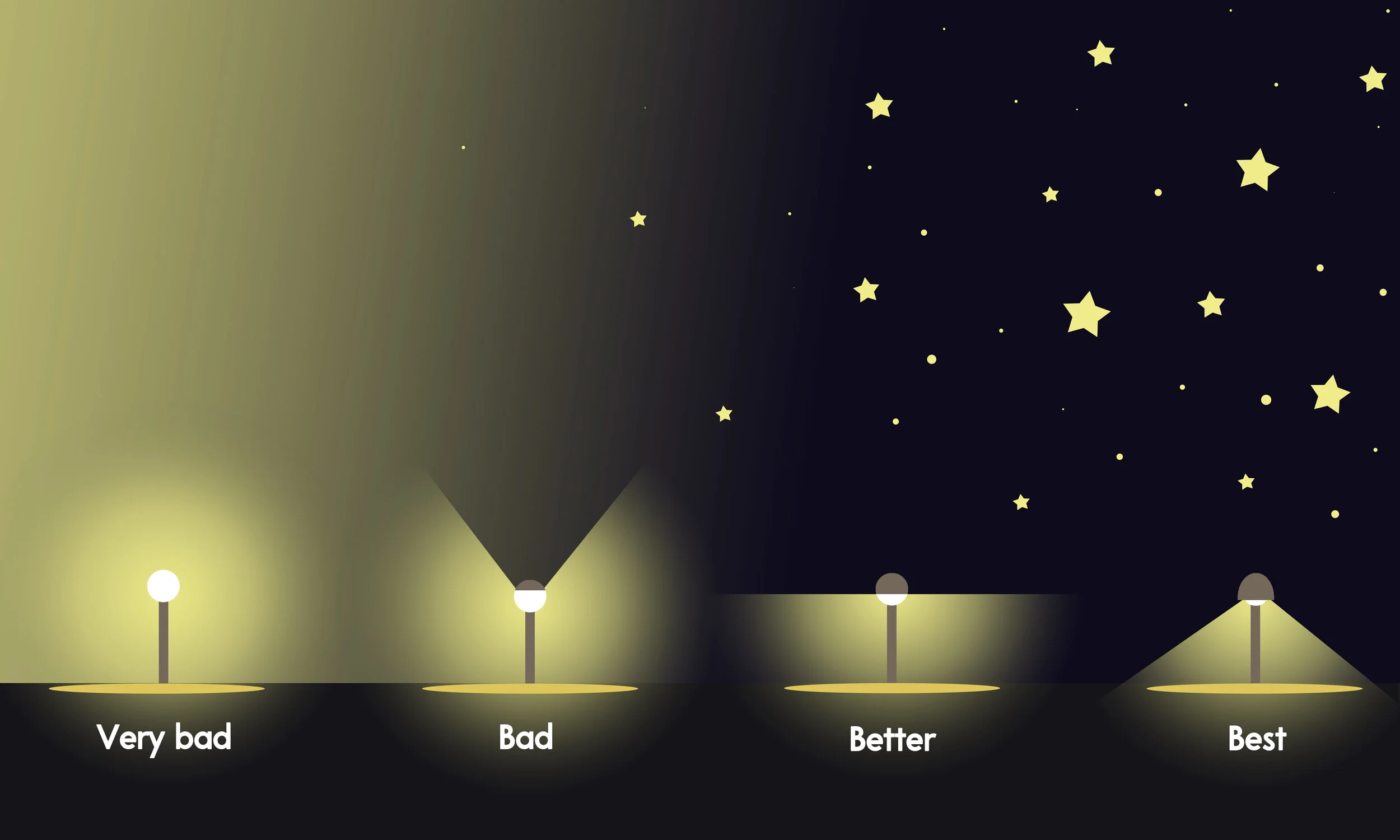
Task lighting: Lighting should be where you need it, when you need it, in the amount necessary. It's not necessary to over-light an area. Task lighting can minimize wasted light by localizing lighting to exactly where it's needed to suit the task at hand. Certain spaces are used sporadically, and certain tasks require less illumination. Always consult your municipality’s recommendations.
Tackling light pollution doesn’t have to be hard or mean giving up high-quality products. In fact, many solutions are low-tech, cost-effective solutions. Through education, we can easily be changemakers in safeguarding our natural environment.
Want an easy way to find dark sky friendly lighting?
IDA’s Fixture Seal of Approval provides objective, third-party certification for luminaires that minimize glare, reduce light trespass, and don’t pollute the night sky.
Four Trailblazing African American Architects You Should Know
America’s very first Black licensed architects started appearing in the mid-1800s following the Civil War. Securing commissions in a white-dominated profession, especially after the enforcement of Jim Crow laws, was not easy. But as African Americans grew their communities, they needed trained architects to build their businesses, banks, churches, schools and more. These trailblazing men and women, who faced obstacles due to overt racism, were the architects that helped to leave a lasting mark of professionalism and workmanship in a multitude of buildings that history often overlooks.
Here are four architects you should know.

Albert Irvin Cassell produced the master plan for the expansion of Howard University’s campus.
Albert Irvin Cassell (1895 - 1969) Born in Towson, Maryland, Albert I. Cassell helped shape American academic communities in Maryland, DC and Virginia. After graduating from the architecture program at Cornell University, Albert Cassell joined the Architecture Department at Howard University. While there, he worked as a professor, architect, land manager, and surveyor.
During his 18-year stay, Albert designed a myriad of notable campus buildings, including the Campus Library, Greene Stadium, the Founders Library, and Baldwin Hall, to name a few. He also branched out from Howard to design buildings at Virginia Union University, several Masonic temples, and Provident Hospital in Baltimore.
After leaving Howard University, Albert went on to design academic buildings for Morgan State University, he worked with the Roman Catholic Archdiocese of Washington, and formed the architecture firm of Cassell, Gray & Sutton.

Cassell helped to design many buildings on Howard University’s campus, including the dining hall, gymnasium, stadium, and (above) the Founders Library,(Founders Library).
Two of Albert’s projects in DC are listed on the US National Register of Historic Places - the Mayfair Mansions Apartments and the Prince Hall Masonic Temple.
Unfortunately, Albert passed away before his promising Chesapeake Heights on the Bay proposal could receive the green light, but he left quite the legacy. Of his eight children, three went on to become architects themselves.
William Sidney Pittman (1875 - 1958) William Sidney Pittman was one of Washington D.C’s most celebrated African American architects in the early 20th century. He most notably designed Washington D.C.’s Zion Baptist Church and the nearby Deanwood Chess House, Maryland’s Fairmount Heights housing development, and the YMCA building at 1816 12th Street NW. His design of the Negro Exposition Building at the Jamestown Tricentennial Exposition in 1907 was the first ever accepted by the federal government by a Black person.
Pittman married Portia Washington, the daughter of the famous Black educator Booker T. Washington, however, Pittman’s beginnings were far humbler. Born in Montgomery, Alabama as the son of an ex-slave laundress and a prominent white man of the city, at 17, Pittman started studying mechanical and architectural drawing at Tuskegee Institute, and later was awarded a scholarship to attend the all-white Drexel Institute in Philadelphia.
William Sidney Pittman notably designed Washington D.C.’s Zion Baptist Church and the nearby Deanwood Chess House, Maryland’s Fairmount Heights housing development, and the YMCA building at 1816 12th Street NW.

William Sidney Pittman designed many buildings in Washington, D.C., including the YMCA on 12st. (Dynecourt Mahon -Public Domain)
When he arrived to D.C. around 1905, he was only the city’s second professional architect. Soon after, he opened his own architectural firm, and he later went on to become member of the Republic Club, an organizer of the Volunteer Fire Company, and member of the Public-School Building Committee.
During this period many African American architects focused on designing churches because those institutions were among the few that could afford to pay an architect. However, Pittman was able to broaden the scope of his work beyond churches to include civic structures, manufacturing plants, structures for higher education, and fraternal buildings.
Pittman later moved to Texas and built the Pythian Temple and the St. James African Methodist Episcopal Church in Dallas. At the time of his death, he was seen as one of the world’s great African American architects.

Charles Thaddeus Russell (Public Domain)
Charles Thaddeus Russell (1873 – 1952)
Charles Russell was the first African American architect in the city of Richmond.
During the height of the early 20th century, Russell designed many buildings in Richmond’s Jackson Ward district, helping to transform the area into a thriving commercial zone, which became known as Black Wall Street of America. Due to segregation, there was a need to design many of the Black-owned businesses, banks, schools, churches, and apartments.
A Richmond native, Russell was trained in carpentry at Hampton Institute in 1899 and later taught at Tuskegee Institute in Alabama, studying drafting and design. In 1907, he returned to Richmond where he worked at Virginia Union University and started taking on architectural commissions.
Some of Russell’s buildings include the Richmond Beneficial Insurance Company building, the Gothic renovation of the Sixth Mt. Zion Baptist Church, an office and apartment building for African American lawyer J. Thomas Hewin, the Riverview Baptist church, and the Saint Luke Penny Savings Bank, the first ever bank founded by a Black woman.
Many of Russell’s buildings have been demolished, but his legacy continues to help tell the stories of the people who lived, worked and thrived in one Richmond neighborhood.

The Sixth Mount Zion Baptist Church (Public Domain).
Norma Merrick Sklarek (1926–2012) Called the “Rosa Parks of architecture,” Norma Sklarek broke through both gender and racial barriers to become known as one of the leading voices in the architecture world.

Norma Merrick Sklarek (Public Domain)
She was the first African-American woman to become a licensed architect in New York in 1954 and California in 1962. She was also the first Black woman to become a member of the prestigious American Institute of Architects (AIA) in 1959, and its first Black female fellow in 1980.
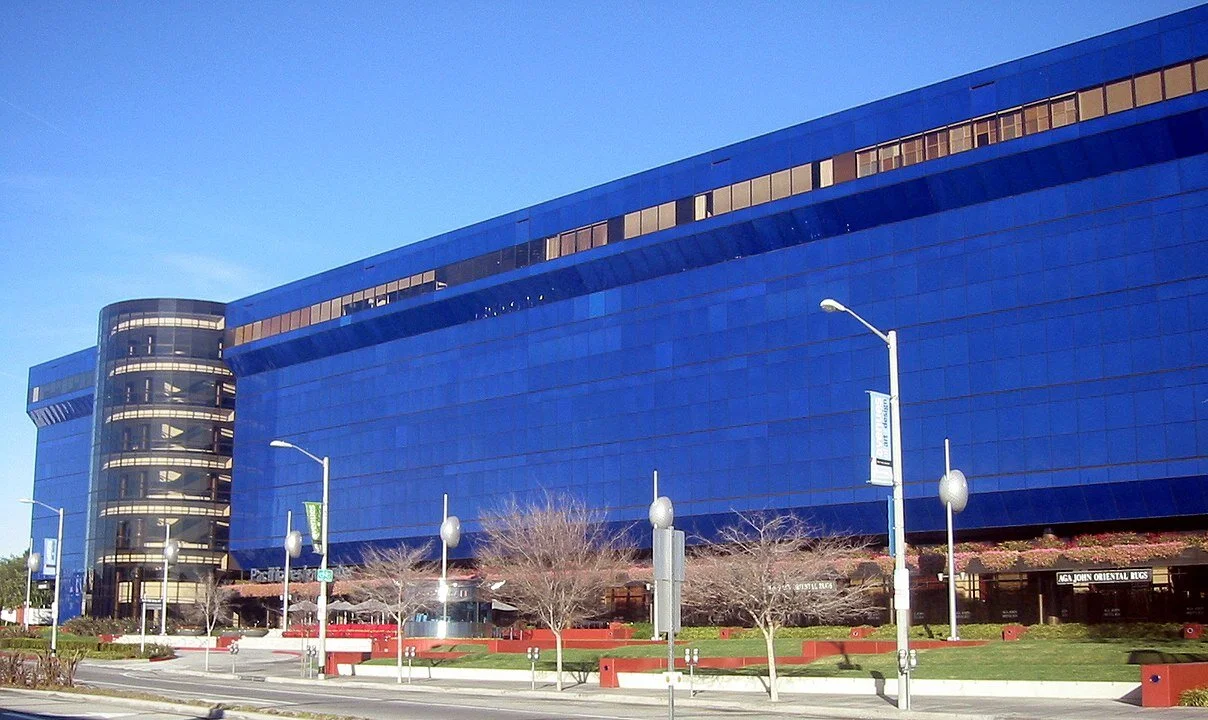
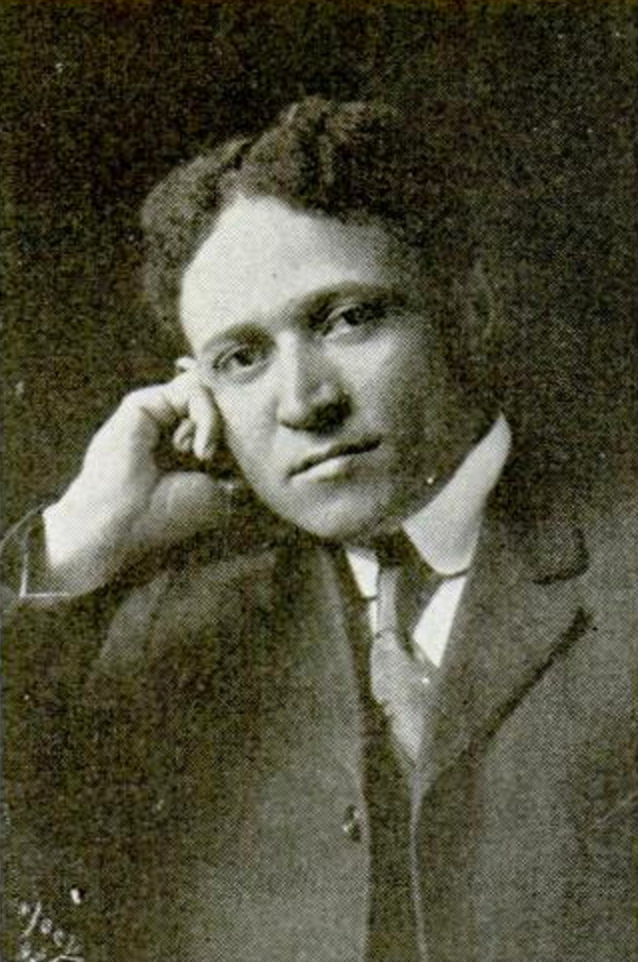
Born in Harlem, New York, Sklarek graduated from Columbia University as one of only two women, and the only Black student in her entire class. After taking a job as a junior draftswoman in the City of New York’s Department of Public Works, she later found a position at Skidmore, Owings and Merrill, a high-profile firm in New York. Four years later she headed to the West coast where she quickly climbed the company ladder at Gruen Associates in Los Angeles, getting named the firm's director in 1966.
Sklarek made her name on leading large commercial and civic projects like the Pacific Design Center in Los Angeles, the California Mart, San Bernardino City Hall, and the Mall of America. Among her best-known projects are Terminal One at Los Angeles International Airport (LAX) and the U. S. Embassy building in Tokyo, Japan.
Sklarek made history yet again in 1985 when she co-founded her own firm, Siegel, Sklarek, and Diamond, which was the largest woman-owned architecture firm at the time.